Anne Midgette is Chief Classical Music Critic for The Washington Post. Her article, “The top 35 female composers in classical music,” was written in response to National Public Radio’s July 2017 article “The 150 Greatest Albums Made By Women.” The NPR article “was inspiring,” Midgette writes,”but where were the composers? In the wake of much discussion about the chronic underrepresentation of female composers on American concert programs, I came up with my own best-of list.”
Midgette narrowed her focus to artists in the recorded music era, naming historic greats like Hildegard von Bingen, Fanny Mendelssohn, and Clara Schumann, before turning to a list of 20th and 21st century composers. The list included two E. C. Schirmer composers, Libby Larsen and Elena Ruehr.
Libby Larsen
Libby Larsen
Libby Larsen (b. 1950) is one of America’s most prolific and most performed living composers. She has created a catalog of more than 200 works spanning virtually every genre from intimate vocal and chamber music to massive orchestral and choral scores. Her music has been praised for its dynamic, deeply inspired, and vigorous contemporary American spirit.
Libby Larsen has received many awards and accolades, including a 1994 Grammy as producer of the CD The Art of Arlene Augér, an acclaimed recording that features Larsen’s Sonnets from the Portuguese. Her opera Frankenstein, The Modern Prometheus was selected as one of the eight best classical music events of 1990 by USA Today.
The first woman to serve as a resident composer with a major orchestra, she has held residencies with the California Institute of the Arts, the Arnold Schoenberg Institute, the Philadelphia School of the Arts, the Cincinnati Conservatory, the Minnesota Orchestra, the Charlotte Symphony, and the Colorado Symphony. Larsen’s many commissions and recordings are a testament to her fruitful collaborations with a long list of world-renowned artists, including The King’s Singers, Benita Valente, and Frederica von Stade, among others. Her works are widely recorded on such labels as Angel/EMI, Nonesuch, Decca, and Koch International.
In 1973, she co-founded (with Stephen Paulus) the Minnesota Composers Forum, now the American Composers Forum, which has been an invaluable advocate for composers in a difficult, transitional time for American arts.
Elena Ruehr
Elena Ruehr
Elena Ruehr says of her music “the idea is that the surface be simple, the structure complex.” An award winning faculty member at MIT, she is also a Guggenheim Fellow and has been a fellow at Harvard’s Radcliffe Institute and composer-in-residence with the Boston Modern Orchestra Project, which performed and recorded her major orchestral works (O’Keeffe Images, BMOP Sound) as well as the opera Toussaint Before the Spirits (Arsis Records). Three of her six string quartets were commissioned by the Cypress String Quartet, who have recorded How She Danced: String Quartets of Elena Ruehr. Her quartets have also been performed by the Biava, Borromeo, Lark, ROCO, and Shanghai string quartets. Her other recordings include Averno (Avie with the Trinity Choir, Julian Wachner, conducting), Jane Wang considers theDragonfly (Albany), Lift (Avie) and Shimmer(Metamorphosen Chamber Ensemble on Albany).
Dr. Ruehr was a student of William Bolcom at the University of Michigan, and Vincent Persichetti and Bernard Rands at The Juilliard School. Elena Ruehr‘s oeuvre includes compositions for chamber ensemble, orchestra, chorus, wind ensemble, instrumental solo, opera, dance and silent film. Her work has been described as “sumptuously scored and full of soaring melodies” (The New York Times), and “unspeakably gorgeous” (Gramophone). Dr. Ruehr has taught at MIT since 1992 and lives in Boston with her husband and daughter.
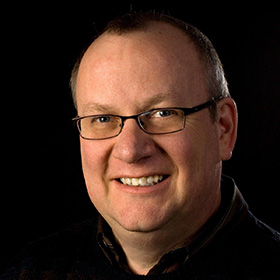
David Cherwien is Cantor at Mt. Olive Lutheran Church (Minneapolis, MN) and Artistic Director for the National Lutheran Choir. Dr. Cherwien is a founding member of the Association of Lutheran Church Musicians and served as the National President from 1993 to 1997. A distinguished organist and director, Cherwien’s choral and organ works account for nearly 70 titles in the MorningStar Music catalog. He is also the editor of our National Lutheran Choir Choral Series.
1. How did you get involved with music?
I guess I just always was involved in music. My parents are both musicians, and played flute together in the Luther College Band under Weston Noble. They both played piano, and I remember Mom, as she was cleaning the piano, would stop to play the same feisty piece every time. I think it was something by Chopin or Rachmaninov. Dad taught high school music (until switching to teaching French when I was 13) and was a professional singer in the Twin Cities. I started piano lessons at age 6, and my grandmother was my primary teacher until I moved on to other things in high school. By then, I was playing in rock bands. In grade school, I was always that nerdy kid who was terrible at anything athletic, but I could play the piano. We were also very involved at Central Lutheran Church in the 60’s: Dad in the adult choir and I in all the children’s choirs, until the whole family went to France for Dad to complete his teaching certification. In France, I started taking organ seriously (or it started taking me seriously I guess) – and I had an outstanding teacher there. I was going to be a high school music teacher, but the church grabbed my attention instead. Throughout my life, it seems as though music, and specifically church music, chose me…not so much the other way around.
2. Where do you look to find inspiration for your music?
When I was younger, recordings of organ music – especially French music, and Paul Manz’s recordings from Mount Olive. Then it was hymn festivals led by Paul. After he quit playing, I used to make an annual trek to Paris and Jean Guillou would make me wild with enthusiasm. People from my church would come up and say, “You’ve been to Paris again, haven’t you? I can hear it!!” And they loved it as much as I did. It’s harder the older I get because the mentors who inspired me all these years are gone and my generation is supposed to be the mentors…but I don’t feel ready, nor done, being the mentee!
3. In addition to your role as Cantor at Mt. Olive Lutheran Church in Minneapolis, MN, you are also the Artistic Director of the National Lutheran Choir (NLC). How do you find these two roles influence your writing?
That’s been fascinating. The church music writing is mainly what the liturgy needs. Psalm setting, various types hymn setting, propers, preludes/postludes – all custom for whatever liturgy I was writing for, with the forces I knew I had. The NLC is more art music – appropriate in a concert setting, able to be more involved. The surprise is that I’ve discovered the two are totally related. Elements of art music can, and actually should, be a part of the liturgical writing. And the NLC has really enjoyed their role in bring more life and creativity to hymnody and scripture! The church writing always begins with the text and finding ways to uncover its music, and most importantly, its meaning. This is also possible for art music! Probably one thing that’s been profound about NLC’s influence on church writing: There’s a difference between simplicity and simplistic. If I’d be embarrassed to bring a church piece to NLC, I should also be embarrassed to give it to the church choir. The bar needs to be high in both places.
4. What has been most gratifying about your work with the National Lutheran Choir?
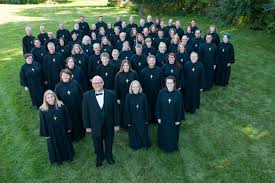
The National Lutheran Choir
That question is much easier to answer. They are such amazing musicians – the way they feel things together astounds me over and over again. They can float into a cadence with an elegance that makes me wild. All I have to do is think in my mind the question, “Do you guys want to float into this cadence?” My eyes communicate that and off they go. So the answer to that question is clearly their musicianship, which is undergirded by their spirituality. It actually means something to them!! We’re also very close friends and really enjoy being together. We know how to “work hard AND party hard.” One without the other wouldn’t really work very well.
5. Describe life as a church musician. Feel free to touch on the joys (and challenges!) of the job.
Joys: It’s been an extremely gratifying career. I’m lucky to be able to have been at churches who hold music as such a high priority. They adequately “take care of the musician” (salary and benefits) so that I don’t need many jobs to try to pay the bills like so many of my colleagues. And there is nothing like that feeling when the whole congregation gets into that zone singing fully together to the point that the accompaniment could be there or not. And when the choir pulls something off beautifully that they never thought they were capable of doing. But again, observing the evidence that what they are singing is deeply, deeply meaningful is humbling and I take the stewardship of that gift which they give to me very seriously.
Challenges: I think most of us church musicians share the same challenge: worry about who’s going to show up. Folks are busy and it’s a tremendous challenge when the make-up of congregation and choir is different week-to-week. We just have to smile and get over that. I have noticed, however, that there is a direct connection between how much time I put into rehearsal preparation and attendance…Another huge challenge is our role as “prophets”- not everyone wants to trust the musician’s expertise as more than mere opinion. Mount Olive is fantastic with trust – and many, many of them know probably more than I do, but still trust my stewardship.
6. What advice would you give to an aspiring young church musician?
Ooo…it’s tempting to get really preachy. But I am willing to relay things I wish did better along the way:
1. People first. Love them first before anything else. Then listening to what’s meaningful and known to them before telling them what I think is better.
2. Keep people first in working relationships between colleagues. Don’t make work relations more about turf protection or egos than being steward of people’s music making.
3. Keep learning a priority. Practicing, attending workshops to learn, reading. I’ve been terrible about this.
4. Don’t get too hurt by critics, and listen before defending/reacting. Nine times out of ten, a vocal critical member has stuff going on which gets projected which has nothing to do with church. Yet often there might be something important to hear even if the topic of their criticism isn’t the real point.
5. Remember the big picture. No era is the most important one ever – either for the people of God since (or before) creation, or our generation, or this month in the life of the parish. Time can heal a lot. Growth can take much more time than we’d like, but in a grander way, is amazingly quick. (Computers were developed during my career!!!)
7. What do you spend your non-musical time?
I love traveling. Seeing places and observing people anywhere else, finding great food and wine – especially if from the region where I’m visiting. It’s also no secret that I’m a car guy. I don’t so much work on them as I do just enjoy driving different cars! Even as a kid, my brother Steve and I used to play with match-box cars on a city we painted on an 8′ x 4′ sheet of plywood. In grade school, I used to go to all the car dealerships on Saturdays, play in the new cars, and collect the brochures (which I still have). As an adult, I’ve had a lot of different cars – 69 different ones so far. They’ve been all over the place – from old, rusty VW Beetles (and a couple of vans, too) to Cadillacs. I just wish some car dealer could come up with a 6-month used car lease program: Pick out a car from their lot, drive it for 6 months, come back, and pick out a different one. That would be heaven.
8. Is there any recent or upcoming news you want to share?
This month (August 2017), NLC starts preparations for the premiere performance of a piece we commissioned from Kim Andre Arnesen, titled The Holy Spirit Mass for choir and strings. The donors for the commission, Gary Aamodt and Celia Ellingson, had envisioned a major work to commemorate the 500 anniversary of the Reformation. It’s an incredible work and we’re premiering it both in Washington D.C. at the Shrine of the Immaculate Conception, the Basilica of St Mary’s (Minneapolis), and the Ordway Theather (St. Paul). The performances are the end of October and we’re very excited about that!
Swiss composer Lionel Rogg‘s 38 Chorals is an organ collection distinguished by a great variety of styles, but the natural harmonization of each melody has been maintained in most cases. Some of them are treated in a Romantic manner, perhaps evoking the sound of Brahms or Reger. In general, the pieces are of medium difficulty, with a few being easier and a few more demanding. The chorals may be grouped for the purpose of playing them in a recital since most are two or three pages in length.
Tom Leeseburg-Lange (St. Paul’s Lutheran Church, Fulton, MD) recently reviewed Rogg‘s collection in In Tempo, the tri-yearly resource journal of the Association of Lutheran Church Musicians. Leeseburg-Lange writes, “My most tantalizing discovery in the preparation of this article was a slightly smaller, contemporary ‘Orgelbuchlein’ from the early 2000s…There should be only applause and accolades for this newer volume. Rogg, who thrice recorded all of Bach’s organ works, has absorbed not only Bach’s spirit but also the style of Brahms in a newer style and distinctly expressive manner.”
Song Source Festival is launching its fourth season by giving life to new works from Minnesota composers, including world premieres of music by Libby Larsen and David Evan Thomas. The concert takes place August 7, 2017.
Libby Larsen‘s Pharoah Songs is scored for baritone and piano and performed by Alan Dunbar (baritone) and Mark Bilyeu (piano). David Evan Thomas‘ work for vocal ensemble and piano duet, To Joy, featured the voices of Mary Wilson (soprano), Clara Osowski (mezzo), Jacob Christopher (tenor), and Tyler Duncan (baritone) alongside pianists Arlene Shrut and Erika Switzer.
Song Source Festival delivers fresh and innovative concerts, recitals, and masterclasses while striving to empower a new generation of performers, composers, and audiences. Source, based in Minnesota, commissions new music from local composers, fosters conversation, and supports Minnesota’s community through a variety of events and programs.
“Fired by local pride, some of Western music’s most passionate works are closely identified with their cultures of origin.”
The Boston Landmarks Orchestra is a summertime tradition for Boston residents. Founded in 2001, the orchestra is comprised of local professional musicians. On August 9, the ensemble shared a concert of music from across the globe. From Sibelius’ Finlandia to Marquez’s Danzon No. 2, the concert featured a wide variety of works for audiences.
Kareem Roustom
The world premiere of Kareem Roustom‘s Aleppo Songs was included in the performance. Originally scored for solo piano, the piece is a reflection of on urban folk songs from Aleppo (known as qudud). Roustom wrote Aleppo Songs with three particular goals in mind:
1) Raise awareness of Aleppo issues and those affected by war.
2) Share the region’s music and culture with new audiences.
3) Raise money for organizations devoted to helping refugees.
“We all know that homelessness is such a major problem…and it doesn’t seem like the government is really handling it very well. The burden seems to be on private citizens… There must be some way that artists can do something.”
Henry Mollicone
Henry Mollicone is an active freelance composer of opera, symphonic, and new music. A widely sought-after commissioner, Mollicone‘s résumé includes an impressive list of work for ensembles like The San Francisco Opera, The Minnesota Opera, The American Composers’ Alliance, and The National Endowment for the Arts. The composer also ranks as a leading composer in writing new works for social justice-related issues. One of these works is Beautitude Mass (for the Homeless).
Beatitude Mass (ECS#6518) for Soprano & Baritone Soli, SATB Chorus (divisi), and Piano or Chamber Ensemble or Full Orchestra
I received a commission from Mid-Columbia Mastersingers America, and was told by director Jana Hart that I could write “anything I wanted to.” What a nice opportunity for a composer to be told that! I have for years wanted to set some classic Latin prayers, and this was my opportunity to do so. These prayers were familiar to me from my youth, and included the famous “Ave Verum.” Of course every classical music music lover knows that prayer because of the exquisite Mozart setting, which I must say caused me to feel a bit intimidated— but having a composer’s ego, I got over it and did it!
2. Beatitude Mass incorporates both Latin and English texts. Tell us about the origins of these texts and why you chose them.
Beatitude Mass is very special to me— not so much for its musical content, but because it deals with the issue of homelessness, and was written to raise money for organizations dedicated to helping the poor. I encourage any choruses doing the work to donate at least some of the funds they raise to such organizations, and it has so far raised over 150,000 dollars for various organizations. I encourage choruses to choose the organizations that will receive such donations. Some nice events have occurred over the years since I composed the work with my librettist playwright William Luce. Some groups have decided to donate to more than one organization; others have featured art created by homeless people, and have sold paintings and sculpture, donating the funds to charities, while others have invited poor people to attend performances. It is so important, i feel, for poor people to know that we are aware of their situations, and want to assist them, as often in the world, they feel alone and abandoned. Of all my works, it is my fervent hope that this one continue to get performances and to make such donations.
I thought it would be a good idea to use the standard Latin Mass texts for the choral movements, while having a baritone and soprano sing the solo roles representing homeless individuals (Evelyn and Adam); their stories were put together from interviews with several homeless people in shelters conducted by Mr. Luce (in Oregon) and myself (in San Jose). In each of the interviews conducted, the individuals had one thing in common: Hope. They all wanted very much to make their own situations better, and worked hard to do so. Some suffered from mental illness, some from addictions, and many from simply not being able to make enough money working to pay rent and support their families. Mr. Luce took all of the interviews, and it was his brilliant idea to use them as the basis for the individual stories of Adam and Evelyn. When I asked him— well after the premiere— why he chose these names, he told me that Evelyn is usually called Eve, and that Adam and Eve after leaving the Garden of Eden were the first homeless people on the planet. And I didn’t even think of that before he told me! In terms of the music, the big choral movements (representing the Divine Spirit) is different from that of the soloists (representing homeless people). The latter music even uses elements from vernacular (popular) musical styles.
3. All of your royalties for this piece have been donated to organizations that support the homeless. Do you know which organizations have received these funds?
As I have been blessed with performances by several choirs, I do not have all of that information readily available, but I can name a few: So Others Might Eat (SOME) in Washington DC and St. Joseph’s Social Ministry in San Jose, CA also comes to mind. The nice thing about these performances is that they were in many different locations in America, so several organizations benefited.
The San Jose Symphonic Choir, under my direction premiered the work at St. Joseph’s Basilica in San Jose, CA in the spring of 2006. The music director of the choir, Leroy Kromm (a wonderful baritone) sang the role of Adam, and his equally talented wife, Nancy Wait Kromm, sang the role of Evelyn. The commercial recording was made from that performance.
Complete List of Performances:
San Jose Symphonic Choir
Stone Church of Willow Glen (San Jose, CA)
Prince of Peace Church (Saratoga CA)
The Unitarian Universalist Church (Palo Alto, CA)
Our Lady of Angels Cathedral (Los Angeles, CA)
St. Mary’s Church (Los Gatos, CA)
The Monterey Symphonic Chorus (Monterey, CA)
The Georgetown Chorale (at the National Shrine of the Immaculate Conception in Washington, DC)
“Like so many of Mollicone’s works, the Beatitude Mass draws on his exceptional musical gifts of melody and harmony to exalt the simple, anguished words of homeless people into haunting and moving expressions…it takes on the universality found in so many great musical settings of the Latin mass. It adds for its finale the ‘Salve Mater Misericordiae’ and, like Brahms’ German Requiem, reprises the opening beatification, ‘Blessed are the poor.’ – Scott MacClelland, Monterey County Weekly
“The Beatitude Massproved an affecting and powerful work, brimming with talent and heart…All who gather under the halo of this choral work — singers, musicians, volunteers, audiences, charitable agencies, tech crews, etc — do so in a spirit of service to their fellow humans. The Beatitude Mass is designed this way. It attracts and supports community fellowship, generosity, kindness, selfless actions and warmhearted artistic excellence. As such, it serves as a true vessel of good that may not only inspire many people to participate in the Mass‘ unique performance legacy but also composers willing to undertake projects similarly dedicated to charitable action. Mollicone‘s masterpiece of music and service seems just the right antidote to constriction in a time of belt-cinching and economic worry. It says, ‘Give happily to those less fortunate and let music lead the way!’ Wouldn’t it be something if the Beatitude Mass sparks a joyful contagion of great music written for charity!?” – Barbara Rose Shuler, The Herald
“Henry Mollicone had been volunteering at a homeless shelter. Then a priest friend put an idea in his head: As a composer, Mollicone might have a more far-reaching way to help. ‘As I was writing the piece,’ Mollicone said, ‘it occurred to me that the chorus (in the Latin sections) represents a kind of spiritual quality — God, if you will. And the … soloists represent humanity, in a very general sense. What I noticed in a lot of these people was hope. They all had very strong ideas about getting their lives back in shape…We all know that homelessness is such a major problem…and it doesn’t seem like the government is really handling it very well. The burden seems to be on private citizens… There must be some way that artists can do something.'” – Steven Brown, The Charlotte Observer
Other available works for social justice by Henry Mollicone:
“Misa de los Inmigrantes may be performed omitting the narration sections between the choral movements, although it is my preference that they be included. The work was written as a tribute to all immigrants in the hope of raising awareness of the injustices in our present immigration system. Its narrative depicts the true story of Guadalupe and her family, and their difficult journey from Mexico to the United States in search of a decent life. My wife, Kathy, interviewed Lupe several times, as Lupe shared all the details of her odyssey for the purpose of making her story public. Her experiences are not unique; they are, in fact, similar to those of so many others who are forced by poverty and violence to leave their homes and seek a better life in America for themselves and their families.” —Henry Mollicone
“All the world’s great faith traditions give thanks for the glory of God’s creation. In recent years they have also worked on environmental stewardship individually, in interfaith partnerships and with private agencies and governments. A Song for Our Planet celebrates that work and integrates sacred texts from the Buddhist, Christian, Hindu, Jewish and Taoist traditions. Out of respect for the beliefs of many Muslims, no verses from the Koran are included out of respect for the beliefs of many Muslims that the Qu’ran must not be set to music; rather, we include passages by Jalal ad-Din Muhammad Ruml, the 13th-century Muslim poet, theologian, and Sufi mystic. The libretto has an arching form that moves from praise of God’s creation and acknowledgement of humanity’s harm of the earth to a commitment for change. It concludes in hope for peaceful coexistence and celebration of all earth’s creatures. We hope that performances of A Song for Our Planet may inspire people to explore ‘creation-friendly’ practices both in their daily lives and in their sanctuaries, classrooms, and concert halls.” —Vicky Thomas and Henry Mollicone
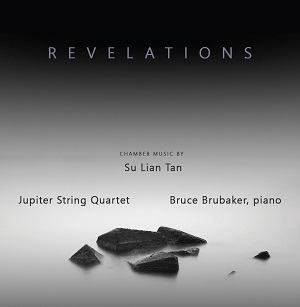
Su Lian Tan is a much-sought after flutist and composer whose music has been described as “the stunner of the evening,” (Washington Post) and “…refined, cultured compositions… Rewarding for everyone…A must-own for flutists and flute enthusiasts” (Fanfare Magazine). Tan is also a Professor of Music at Middlebury College in Vermont. Arsis recently featured three of her chamber and piano works, performed by The Jupiter String Quartet and pianist Bruce Brubaker, on a new album, Revelations (CD 181), which already received praise from bothGramophone and Fanfare magazines. Su Lian Tan gave us a a behind-the-scenes look at working on the album, along with insight into her musical background and interests.
1. What was it like to work on Revelations with The Jupiter String Quartet and Bruce, and to see them in action?
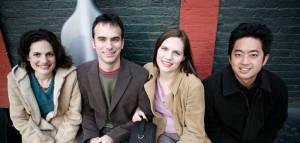
The Jupiter String Quartet
Recordings are an amazing opportunity, and when you get to work with inspired people like The Jupiter and Bruce, it becomes a joint adventure. Bruce and I are friends from Julliard days, while The Jupiter and I met and became friends very quickly. The album came together in terms of the musicians. Then, of course, everyone was fully booked and scheduling became quite the issue. But we all hung in there, I’m glad to say, and when you hear the album you’ll know why. Together, we pushed each other towards gold!
2. Tell us a little about the works included on the album and where you found inspiration for them.
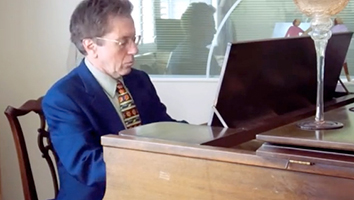
Bruce Brubaker
These are powerful musicians at the height of their game, as are the dedicatees of the works. For example, Life In Wayang was commissioned and toured by the Takacs String Quartet. At the time, their repertoire often comprised of Beethoven and Bartok string quartets, which I admire greatly. They are unique in many ways as well, so a lot of the beauty and refinement of their playing and the serious depth of understanding was on my mind. You can also imagine that The Jupiter was an excellent choice for recording it, being such wonderful musicians and establishing a marvelous sound of their own. The piano quintet, Revelations, was dedicated to Sophie Shao and my friend and colleague Paul Nelson, the former director of the Performing Arts Series at Middlebury. Many of the cello solos were meant for a cello voice which is lyrical, mellifluous and full of nuances. It is wonderful to hear Daniel McDonough take over those sections and own them, expressing opera through the cello. Bruce became the obvious choice for the pianist because he is one of those rare musicians who encompasses the broadness of Brahms, undesrtands a huge spectrum of idioms, is profoundly intellectual, and now enjoys rock-star status in Europe, Asia, and the U.S. He would know what to do with a piece dedicated to another wonderful intellect, who among his other interests, is a scholar of Aristotle.
3. What is your favorite thing about recording an album?
I love being in the sound booth and being the one to capture what audiences will hear. When I recorded my flute album at WGBH, I had both Antonio Oliart and Bob Schuneman listening to me. I know how great it feels to have support and not to feel left out in the cold when recording. My husband, Evan Bennett, listens to all of my music with such care, too, and advises me in a way only a person who understands my assertions and goals can. He is the person I trust most with supporting the creative process in all its layers, from the initial counterpoint to aspects of performing and performance, so that I can be confident about my output. When my opportunity arrives, I try to act as if I’ve been “coach” all along. I’m also quite a freak about careful and specific microphone placement to get good values to work with. That way, the engineer who masters the album (in this case David Trembley) has enough material to create the best possible sound. He developed an exponentially wonderful architecture here. At the risk of sounding boastful, many musicians regard me as one of the best producers around (and apparently conductor, too). Although I know they are teasing me about it, I’m getting ready to produce for The Jupiter’s next album…hopefully Beethoven!
I went to elementary and high school in Kuala Lumpur (Malaysia), and that’s where I started playing and studying music, first the piano, then the violin, and finally the flute. I had always wanted to play flute. The British Council had a nice recital space, and I heard a concert there performed by a glamorous American flutist. I was just enchanted. But with wind instruments, you have to wait for your lungs to grow a little bit before you start. I started it last, and ended up with the flute as my main instrument. I could have played on Malaysian and Chinese flutes, but the sound of the Western flute was what I was always after. My father would only have been comfortable sending me to an English-speaking country for college, as I was a little bit under-age. We chose Bennington College for a lot of reasons, but mostly because it was such a highly artistic school. We knew I would get to perform there, and that the teachers would be fantastic. I composed at Bennington College (Vermont) because I had to. Everyone in music there had to compose and know what all of that was about. This is so valuable and that’s why we have implemented the same concept here at Middlebury College. My first class was with the great Vivian Fine. It could not have been more inspiring for me to hear and see the music of a female composer. At the same time she was so full of gravitas and fun. What a character! Exactly as her music is.
Somewhere between By Leaps and Bounds and Autumn Lute Song (available from Theodore Presser), I started writing in what would become my voice. I didn’t know it was my voice yet. It was Milton Babbitt at Julliard who encouraged me to be all that I am. When you are young, you try to learn the theory and philosophy behind Western music. But that wasn’t all that I was. By Leaps and Bounds is the first piece in which I unmistakably let the Asiatic roots show, in the form of gamelan influence. Autumn Lute Songalso has that voice in which the Western philosophies fuse with Chinese idioms and gestures.
6. What is your process for writing new music?
Recently, if I’ve agreed to compose something, it means I’m awfully inspired by the dedicatee(s). Their personalities, style of playing, and uniqueness soften translates directly into gestures, and sometimes note palates, that then evolve into musical material. Sometimes these thoughts and observations inform the larger view of the piece as well.
7. You are a Professor of Music at Middlebury College. How do you balance life as a composer with your teaching?
My students keep me on my toes. In fact, they are usually so cool that they make sure I am, too. They have a way of keeping everything fresh and new, a constant sharing of ideas and art. I’m very lucky to have had such a good time with so many wonderful musicians at Middlebury both current and former students, and of so many different genres. Here’s a short list; concert composers include Christina Whitten Thomas, Mary Montgomery Koppel, and Matthew LaRocca. Indie artists and jazz musicians include Dispatch, Anais Mitchell, John Colpitts (of Man Forever), and Jason Ennis (of La Voz Tres). As I mentioned…..I’m lucky!
8. How do you spend your time when you’re not writing or teaching music?
I eat good food!:) And a little known fact (but not exactly a secret either) is that I’m an award-winning leather artist. There’s always an art project on my mind: cowboy boots or a western-inspired evening clutch, which I’m intending to make with my sister.
Leather ClutchLeather Boots
9. Is there any recent or upcoming news you want to share?
So happy that Revelations, this labor of love, is finally out. I’m starting to talk with Carol Wincenc and John McDonald about a new album of flute music. Recently, I discussed doing a piccolo concerto with Nicola Mazzanti, who is such a fine performer. I’m truly excited about this! A CD release containing my cello concerto Legends of Kintamani (concerto coming soon from E. C. Schirmer) is due to be released imminently. I am so pleased about how it all turned out. Tim Weiss and the young musicians at Oberlin gave it a fantastic go. Both Revelations (the album) and Legends of Kintamani were also submitted for a Grammy!
Click here to learn more about Revelations.Click here to learn more about Su Lian Tan.
The concert included the world premiere of Hagen‘s Lilly Sketches, based on the beloved mouse who stars in Kevin Henkes‘ popular children book, Lilly’s Purple Plastic Purse.Hagen based this arrangement for woodwind quintet on a 1998 commission from the Wisconsin Youth Symphony Orchestra for narrator and orchestra.
Gwyneth Walker‘s FUN-damentals of Music(2004) for woodwind quintet with audience participation is made up of four movements: “Rhythm,” “Melody,” Harmony,” and “Form.” This commission by the Equinox Chamber Players serves to be both fun and educational. Each movement focuses on one component of music, the members of the quintet lead the audience in a series of clapping, humming, and arm movements.
The Wintergreen Festival Orchestra, under the direction of Mark Russell Smith, recently performed Daron Hagen‘s Postcards from America (1996). The performance took place as part of the Wintergreen Summer Music Festival on August 5, 2017. This work received its premiere in 1996 and was co-commissioned by the Oakland East Bay and Waukesha Symphony Orchestra.
Postcards from Americais a collection of six musical portraits, dedicated to people and places in Hagen‘s life.
Yaddo, Summer 1988
Lake Mendota, Summer 1981
Saint Mark’s Place, Autumn 1990
Mount San Angelo, Winter 1988
Delancey Place, Autumn 1983
The Dakota, October 1990
Hagen explores each movement in depth on his website, and offers the following note: “Each movement was composed at the time and in the place noted in the title, assembled and orchestrated during July and August of 1996 in New York City and completed on August 17, 1996.”
Mark Russell Smith
Mark Russell Smith is the current Music Director and conductor of the Quad City Symphony Orchestra and Artistic Director of Orchestral Activities at the University of Minnesota. A champion of the music of our time, Smith led the St. Paul Chamber Orchestra’s Engine 408 series, working closely with living composers and added his unique perspective to enhance that orchestra’s great tradition of fostering new works. He has collaborated with YoYo Ma and members of the Chamber Music Society of Minnesota in Hún Qiáo (Bridge of Souls), a concert of remembrance and reconciliation featuring world premieres by Korean, Japanese, Chinese and American composers. He is a graduate in cello performance of the Juilliard School, where he studied with Claus Adam, and of the Curtis Institute of Music, where he studied conducting with Max Rudolf and Otto-Werner Mueller. While at Curtis, Smith was first prize winner in the National Repertory Orchestra Conductors Competition, and upon graduation, was named Assistant Conductor of the Opera Company of Philadelphia and the Philadelphia Singers. From 1989 to 1994, Smith served as Associate Conductor of the Phoenix Symphony Orchestra and from 1992 through 1999 served as Music Director of the Cheyenne Symphony Orchestra.
Eileen Guenther‘s groundbreaking study of slavery and spirituals is the first to place the unique voices of an enslaved people squarely within the context of their daily lives. Dr. Guenther‘s deeply researched account weaves a succinct history of “America’s original sin” into an examination of the role of singing and religion in slave life and directly correlates slave testimonies—in their own words—to the themes of Spirituals. In addition to surveying the musical styles, performance practices, and melodic and rhythmic characteristics of spirituals, In Their Own Words includes a biblical concordance to 100 of the spirituals most frequently sung. In Their Own Words: Slave Life and the Power of Spirituals continues to be named a useful tool and resource for musicians, conductors, scholars, teachers, pastors, and singers in programming, performing, and understanding the history of the Spiritual.
David Vogels, CAGO, examined In Their Own Wordsin a recent issue of American Guild of Organists. Vogels writes: “Slavery, one of the most shameful aspects of American history, has become a focus of cultural attention in recent months. Into the tempest of activity comes a new book by former AGO President, Eileen Guenther, In Their Own Words: Slave Life and the Power of Spirituals…There could be no better time for us musicians to consider the impact of spirituals on our culture.
True to its title, the fabric of the book is woven from these descriptions ‘in their own words.’ It’s not bedtime reading; as Guenther told another interviewer, ‘These are powerful stories. I couldn’t read the slave narratives in bed at night. They haunted my sleep.’ But they do offer a gripping insight into the history of that period, and they are essential to an understanding of the music. ‘Spirituals are snapshots,’ Guenther observes in the book. ‘They paint many-faceted pictures of an enslaved population in the words of slaves as they describe their housing, food, clothing, resistance, and evangelization.’ With that in mind, the book is organized into two major sections, one on history and one on slave life. Each chapter is headed by the title of an appropriate spiritual.
Since Guenther herself doesn’t expect too many working musicians to read the 492-page volume from cover to cover, I asked her for a few practical recommendations. You can get a good perspective, she indicated, by reading the introduction, perhaps the first chapter on the ‘Origins of Spirituals,’ and then Part III, which includes a summary of the evolution of spirituals after the Civil War, an overview of spiritual themes, and a synopsis of the entire book. Guenther also recommended chapter 5, ‘Witness,’ in which numerous spirituals, organized alphabetically, are elucidated by specific slave narratives.”
John M. Bullard wrote a compelling review for the July 2017 issue of The Diapason. “This is an intensely moving book,” Bullard writes.
“[Slavery’s] vile aspect is exposed in Eileen Guenther’s new book as the key motivation in the anonymous creation of Negro Spirituals, which she dubs ‘among the most powerful music ever created.’ Utilizing thousands of primary sources, notably letters by participants and observers and actual interviews in the 1930s with living former slaves in their own words (a project of President Franklin Roosevelt’s Works Progress Administration), she paints a truly devastating picture of the most shameful aspects of American slavery. That picture is indispensable to any authentic understanding of the creation of Spirituals, and it helps explain their disarming poignancy when performed.
A most valuable chapter (18) devoted entirely to the Themes of Spirituals, and a concluding chapter (19), Slavery and Spirituals: a Synopsis, wind down this powerful narrative. Finally, and of the usefulness to busy church musician, appear two appendices: A. 100 Spirituals: A Biblical Concordance, and B. 100 Spirituals: A Reverse Concordance. These brief, insightful exegetical comments on the lines of the texts, tie the Spirituals to their biblical roots and enable directors and clergy to make maximum use of this rich heritage in worship and other programming.
Eileen Guenther has provided an authoritative, scholarly, historically, informed, and practical resource that no church musician can now afford to be without. To ignore this indisputable treasure of distinctly American music for worship in these times of sporadic racial disharmony is criminal.”
Eileen Guenther is an initiate of the Beta Beta Sigma Alpha Iota Chapter at the University of Kansas, in addition to an affiliation with the Washington DC Alumnae Chapter. The SAI National Magazine, Pan Pipes, included a review by Rev. Michelle Whitlock (United Methodist Church, Northeastern Pennsylvania) in their Summer 2017 issue.
Whitlock writes, “In Their Own Words: Slave Life and the Power of Spirituals offers a detailed look at the life of slaves and the music they created…The work is very thorough and spans over 400 pages of powerful reflection on the words of slaves and abolitionists.
Guenther‘s unique approach to the work is to employ first hand testimony as a primary source…Who can better share about the life, faith and music of the slaves then slaves themselves? Scholars, musicians, and pastors will find this approach helpful in their work around slavery and spirituals.
Guenther‘s work is detailed and complete. I recommend the entire work…”



















 In Tune blog