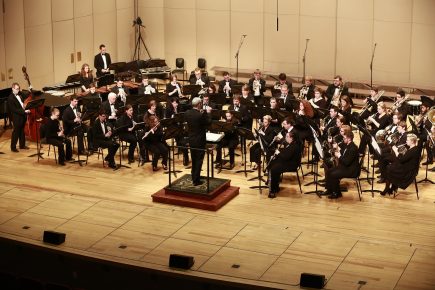
Commissioned by the College Band Directors National Association in 1998 as a derived work from the commissioned opera Bandanna, Bandanna Overture was first performed February 24, 1999 by the Small College Intercollegiate Band conducted by H. Robert Reynolds, as part of the CBDNA 1999 National Convention. The work is not included in theatrical productions of the opera; it exists solely for performances in the concert hall.
An intentionally filmic and emotionally-overwrought blowout exploring the themes of betrayal and death, Bandanna Overture begins with an introduction juxtaposing two ideas: a recurring rhythmic motive which, in the opera is associated with the beating of Mona’s heart, and a melody to which the women of the tiny border town cry, ‘Santa Maria, Salve!’ This is followed by a seven bar refrain based on music from a fist fight in the opera’s first scene during which townspeople are singing things like ‘Beat him to death!’ and ‘Slap on the cuffs!’ The introduction is followed by the first major section of the overture which weaves together two melodies — one to which the character Jake sings, ‘Donde esta mi querida?’ and the other to which the chorus sings, ‘To live is to sleep; to die is to awaken.’ The refrain is then expanded to include a tune to which the chorus sings the words, ‘Day of the Dead: Dia de los Muertos.’
The second section juxtaposes two more themes from the opera — one to which the character Kane sings, ‘Off the hook, all of you working the onion fields!’ and the other to which the chorus sings, ‘Dona nobis requiem.’ The third section, marked ‘Like the Main Title of a ’30’s Melodrama,’ is the melody with which the opera begins, climaxes and ends. The first time it appears, a chorus of Migrant Workers sing the words ‘We strike out across the river, with our lives between our teeth’ as they plunge across the Rio Grande from Mexico to the United States; the second time we hear the melody it underpins the scene in which Morales ‘crosses over’ from jealousy to madness; we hear the melody a final time at the opera’s close, immediately after Mona’s death, when her soul is passing from this world to the next across a metaphorical River Styx.
The overture ends as the opera opens and closes, with the recurring chorale melody whose words at the beginning of the opera, ‘To live is to sleep; to die is to awaken’ and ‘Dona nobis pacem‘ have returned at the opera’s end with greater, sadder significance.
“Infusing softness of tone with luscious harmonies, [Chatman’s] music always sounds deceptively simple…” – Dianne Wells, The Whole Note
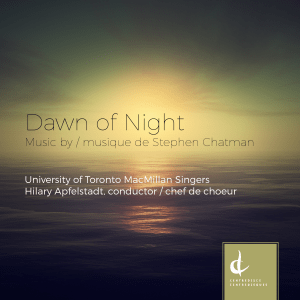
Centrediscs released the latest album of choral music by Stephen Chatman this month. Dawn of Nightis the inspiring new album featuring the voices of the University of Toronto’s MacMillan Singers, under the direction of Hilary Apfelstadt. Chatman’s expertly-crafted pieces are both eloquent and moving, aptly performed by the MacMillan Singers.
Chatman’s works on this CD represent texts from Sara Teasdale, Walt Whitman, Christina Rossetti, Joanna Lilley, and Archibald Lampman. A few pieces feature texts by poet Tara Wohlberg, his wife. In an interview with Centrediscs, Chatman describes how the duo collaborates on musical projects. “We first discuss themes, mood, length, tempo, etc. Typically, Tara writes several or many lines. Then I set some or all of them, omitting or repeating lines, sometimes asking her to change or add words or lines, and discussing any changes during the composition process…She always has veto power over words.”
Many of the pieces featured on this album are available from Galaxy Music Corporation. Click on the cover images below to learn more about each title and hear the sample recording.
San Francisco’s Lowell Trio just released Volume II of its “Music to Save Our Endangered Lands” CD series, which includes Juliana Hall‘s Rilke Song for English horn and piano, and David Conte‘s arrangement of Sometimes I Feel Like a Motherless Child for oboe, cello, and piano.
The Lowell Trio consists of oboist/English horn player Janet Popesco Archibald and cellist Emil Miland (both members of the San Francisco Opera Orchestra), along with pianist Margaret Fondbertasse (Skyline College faculty accompanist). Sales of the trio’s two CDs support the work of the John Muir Land Trust to permanently preserve more beautiful places throughout Alameda County and Contra Costa County, in northern California, for recreation, wildlife habitat, and scenic views.
David ConteJuliana Hall
Hall’s Rilke Song is heard in a stunning performance by Archibald and Fondbertasse, alongside the Trio’s beautiful presentation of Conte’s Sometimes I Feel Like a Motherless Child; the remainder of the CD includes many original works by composers from Bach and Brahms to Andrew Lloyd Webber and Paul Desmond.
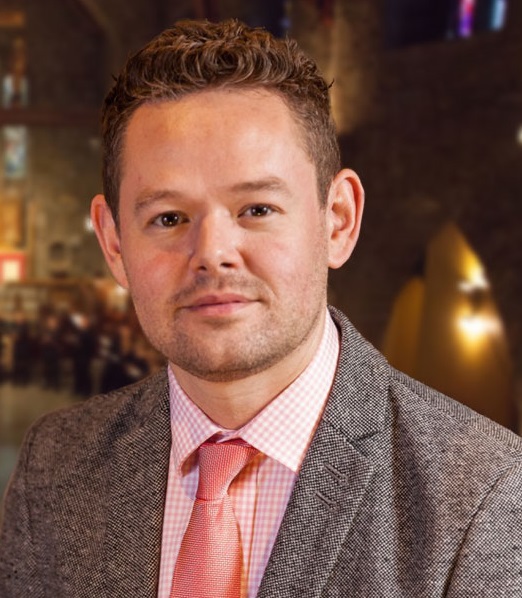
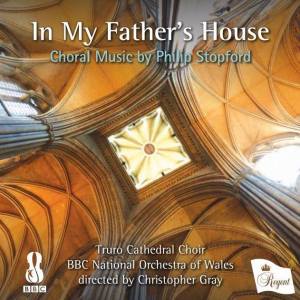
Philip W. J. Stopford (b. 1977) is an English composer and choral director, revered worldwide for his contemporary settings of traditional Latin and English prayers and hymns. Stopford’s relationship with church music is a long one, beginning as early as 7 years old. As of 2016, Stopford has served as Director of Music at Christ Church, Bronxville. He continues to be avidly involved leading workshops, concerts, and recording sessions across the world. His latest album of choral music features new orchestrations of In My Father’s House; Jesu, Lover of My Soul; and O How Glorious Is the Kingdom.
I have had a long association with Truro Cathedral, having been appointed Organ Scholar in 1995, aged 18. At that time, the Director of Music was Andrew Nethsingha, now Director of Music at St. John’s College (Cambridge) and the Assistant Organist, Simon Morley, now at St John’s Episcopal Church (Tampa). The current Director of Music at Truro is Christopher Gray, and I have previously composed a number of pieces for the choir; an arrangement of the Sans Day Carol, and a setting of the Magnificat and Nunc Dimittis for 4 voices, The Truro Evening Canticles, published by MorningStar Music. In 2012, Christopher and I discussed the idea of recording a CD of my sacred choral music called ‘Do Not Be Afraid’ which has sold in the thousands. Working with this choir is a very special experience, and through Christopher’s connections with Tim Thorne at the BBC National Orchestra of Wales, ‘In My Father’s House’ was recorded back in February, and will be released this month (September 2017). Working with this wonderful choir and orchestra was a once-in-a-life-time opportunity; amazing!
2. What is most gratifying about the recording process?
The actual recording was made in just 10 hours! Sixty-five orchestral players, a number of producers, and sound engineers traveled 200 miles from Cardiff in Wales to Truro in Cornwall to make this new recording in the wonderful acoustics of Truro Cathedral. However, there was a large amount of planning and organizing before the two-day recording took place. The Cathedral had to be closed to visitors, the BBC truck had to be parked outside in the small streets of this delicate city. The orchestral manager and his team brought plenty of music stands, lights, and even heaters to keep the players comfortable and happy. This was a mammoth operation. For myself, as the composer preparing for this team of highly professional singers and players, my work was done four months in advance. I locked myself away in my apartment, saw very few people, hardly went out, and orchestrated seventy minutes of music originally composed for choir and organ/piano. The first score took me three weeks, but as the days went on, I was able to work more quickly, and understand FINALE (the music computer program) more efficiently. After all this hard work, the gratification came hearing and seeing this music for the first time in the recording sessions with over 100 performers, the youngest perhaps aged 10. One of the boy choristers said to me, “What does this sound like all together?” I said, “I don’t know, but you’re about to find out at the same time as the composer!” When you purchase the CD, you have the opportunity to experience this moment.
3. How did you get involved in music, and what drew you to composing?
I have been involved in church music for many years, as a Chorister at Westminster Abbey, Organ Scholar at Keble College, Oxford, Truro, and Canterbury Cathedrals, Assistant Organist at Chester Cathedral, Director of Music at Belfast Cathedral, and now as Director of Music at Christ Church, Bronxville, NY. I love church music and simply had a go at composing some of my own, and people seem to like it! From there, commissions, performing, and recording opportunities have always arisen.
4. Describe your compositional style. What inspires your music?
My compositional style is British, having grown up in the Anglican choral music world. There is only one inspiration in every piece of choral music: the words. It all begins here, and develops according to the abilities of the commissioning choir. For me, it is no more complicated that this, and this simplicity seems to identify with those who sing it.
5. In addition to your work as a composer and role as Director of Music at Christ Church (Bronxville, NY), you are widely-sought after as a clinician, organist, and conductor. How do you find time to write music in spite of a busy schedule?
I have a very understanding rector and church – I work four days a week for Christ Church, which allows me time to be Philip Stopford, the composer. My rector sees this as an important part of who I am, and has respected and understood this part of my life in music. I am lucky!
6. How do your roles at Christ Church and as Director of the Ecclesium Choir (UK) influence your music?
I wouldn’t say that my role of conducting choirs influences my music because my compositions all come from the sacred text and its meaning. I have recently composed a setting of the Episcopal Church Eucharist for Bronxville which is designed to be suitable for our congregation (who sings well) and Jesus Christ Is Lord, an anthem suitable for Good Friday, for the church choir. The advantage of running the choir for that which you are composing is you know what they can and can’t do, even down to the individual voice parts!
7. When you’re not leading music at Christ Church, composing, or conducting, how do you spend your time?
Living just 30 minutes from NYC, I enjoy exploring The Big Apple and all that it has to offer – museums, galleries, restaurants, the theater, concerts, parks. It’s a wonderful place to live. Of course, I also have my family and friends in England, Northern Ireland, and the Republic of Ireland, so I have two lives; one each side of the Atlantic! I also get visitors from back home which is lovely.
8. Is there any recent or upcoming news you want to share?
In addition to MorningStar Music, some pieces are published by Hal Leonard, and others are self-published at www.philipstopford.com. I am guest conductor at a number of workshops this year in Nashville, Charleston, Chicago, Dublin, and Bath.
Cellist Darrett Adkins released Myth & Tradition, a new album of music that he commissioned. The recording includes Su Lian Tan’sLegends of Kintamani. Adkins partnered with the Oberlin Contemporary Music Ensemble, directed by Timothy Weiss, to premiere this work.
Tan writes, “Legends of Kintamani was inspired by travels to Southeast Asia and specifically Bali. The five movement storytelling form depicts a return to a more innocent time, one where mythology and reality combine in fairy tales.
The piece opens with an invocation, a chorale-like ode to the landscape. The Garuda swoops in and forcefully claims his status, calling to his minions and commanding the forces of nature. At the end of the movement he performs Silat, a Malaysian form of stylized combat. He alights having been beguiled by a rainbow and sings a serenade to her. Night falls, and the Solo Cello evokes a soft veil surrounding the environment. The forest creatures come to a rest while mysterious sounds and voices emanate from different corners of the landscape. Gamelan textures lead the way into the morning, an aubade signifying a joyous new beginning.”
Legends of Kintamani will soon be available from E. C. Schirmer.
Darrett Adkins
Darrett Adkins is Associate Professor of Cello at Oberlin Conservatory. Adkins has commissioned and been the dedicatee of many important new works for cello, including concertos by Su Lian Tan and Philip Cashian, as well as Jeffrey Mumford’s concerto, which Adkins premiered with the Cleveland Chamber Symphony. He performed the U.S. premieres of Birtwhistle’s Meridian and Donatoni’s Le Ruisseau sur l’escalier at Tanglewood, and the New York premieres of Rolf Wallin’s Grund at Carnegie’s Zankel Hall, Arne Nordheim’s Tenebrae (Alice Tully Hall), Messiaen’s Concerto for Four Instruments (Carnegie Hall), and Berio’s Sequenza XIVa (with the International Contemporary Ensemble), which Adkins also recorded for Naxos’ complete set of Sequenzas.
An avid chamber musician, Adkins performs and records in the United States and Europe with the Lions Gate Trio. He is a former member of the Zephyr Trio and the Flux Quartet, with which he gave the first complete performance of Morton Feldman’s Quartet II and made the subsequent recording on Mode Records. He has recorded with the Juilliard Quartet and been a guest at the festivals of Melbourne, Oslo Chamber Music, Ojai, Aspen, Tanglewood, and Chautauqua. He has performed standard concerti with the Orchestra of St. Luke’s, Tokyo Philharmonic, Suwon Philharmonic, National Symphony of the UFF in Rio de Janeiro, and the symphonies of New Hampshire and North Carolina.
Deemed as the New York Classical Review’s “Critic’s Choice for the 2017-18 season” the annual Time’s Arrow Festival is a celebration of music and arts in the new world. This highlight of New York’s musical season features The Choir of Trinity Wall Street and NOVUS NY, under the direction of Julian Wachner.
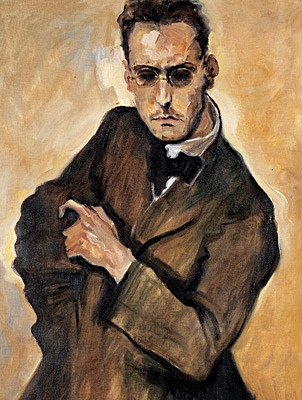
Anton Webern
The 2017-18 and 2018-19 series of Time’s Arrow concerts focuses on the complete works of Austrian serialist composer Anton Webern. The festival presents Webern’s works alongside those of the early contrapuntal composers whose direct descendant he considered himself to be, as well as a sampling of works by the later composers he inspired. The festival’s examination of Webern and the turbulent times in which he lived explores how an artist’s work relates to personal politics and whether the two spheres can be separated.
Fall concerts take place September 12-14, 2017. Click here to see the programmed repertoire.
On September 29, a new opera from Cerise Jacobs and Julian Wachner, Rev. 23, premieres at Boston’s John Hancock Theater. The premiere kicks off the Boston New Music Festival and features White Snake Projects production company, who shares new, relevant opera based on the stories of Cerise Jacobs. Rev. 23 will be available soon from E. C. Schirmer.
Plot Rev. 23 is the sequel to the Book of Revelations. It is told from the perspective of St. John the Divine and “transcribed” by Cerise Lim Jacobs. The opera narrates the last battle to recapture Paradise-on-Earth and restore the balance of good and evil to our world. Persephone, the only being able to pass freely between Hell and Earth, is recruited by Lucifer in the fight against the rulers of Paradise-on-Earth. No one is exempt from this battle. The opera transcends the Biblical narrative, and pulls characters from mythology and Chinese history.
Librettist/Creator
Cerise Lim Jacobs has earned a place as one of the most creative and imaginative thinkers of our time. Born in Singapore, Jacobs eventually moved to Massachussetts where she worked as a trial partner at one of New England’s largest law firms, practicing law for more than two decades. Three years into her retirement, a song cycle written for her husband turned into her first, full-length opera Madame White Snake. The music by Zhou Long won the Pulitzer Prize in 2011.
Jacobs writes, “I dreamed up REV. 23 one day as I was thinking of where I would meet my husband Charles again since he passed from this world. It amused me that my incorrigible, irascible and impossible husband wouldn’t be caught dead (pardon the pun) in Paradise (not that he’d be entirely welcome there) as some of the most interesting people seem to be consigned to that other place. This led to more musing about what Heaven was like and concomitantly, what that other place was like.
I was aided in these musings by the fact that I was a Singaporean Methodist, a product of an American Methodist Missionary school and deeply steeped in biblical lore. So I turned, naturally, to the most detailed account of Paradise-on-Earth familiar to me, the divine visions of John of Patmos, author of the Book of Revelation.
Poring over the Book of Revelation over and over again (it’s a very short book), I couldn’t shake away the sense of unease that grew stronger with each read, that perhaps I wouldn’t be perfectly happy in a place of perfect happiness. As I began to explore why I felt uneasy, the framework for Rev. 23, the final chapter of the Book of Revelation, began to take shape.”
Composer
Julian Wachner, Grammy-nominated composer, is one of North America’s most exciting and versatile musicians, sought after as composer, conductor, educator and keyboard artist. He is currently Director of Music and Arts at Trinity Wall Street and Music Director of the Grammy award winning Washington Chorus.
With over 80 works in his catalog, Wachner’s music has been variously described as “jazzy, energetic, and ingenious” (Boston Globe), having “splendor, dignity, outstanding tone combinations, sophisticated chromatic exploration…a rich backdrop, wavering between a glimmer and a tingle…” (La Scena Musicale), being “a compendium of surprises” (Washington Post), and as “bold and atmospheric”, having “an imaginative flair for allusive text setting” and noted for “the silken complexities of his harmonies” (New York Times.) The American Record Guide noted that “Wachner is both an unapologetic modernist and an open-minded eclectic – his music has something to say.” In 2010, He made New York City Opera history when he was selected as both conductor and composer at the company’s annual VOX festival of contemporary opera leading to the invitation to be the sole conductor of this Festival in 2012.
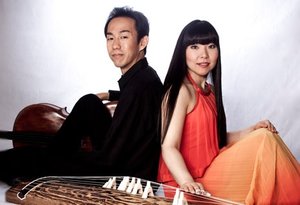
Duo YUMENO (Yoko Reikano Kimura, koto; and Hikaru Tamaki, violoncello) commissioned American composer Daron Hagen to create four large-scale works for koto and cello based on characters and stories from the great Japanese epic, The Tale of Heike. The project is titled “Songs of Heike,” the third installment of which is called Misterioso. The world premiere performance takes place on Saturday, September 9.
About Misterioso
Photo by John Broughton
The third duo tells the story of Kogō (portrayed by the koto), Takafusa, and the Emperor’s man, Takakuna (both men are portrayed by the cello). Kogō was the most beautiful lady and the finest koto player in the palace. Takafusa’s love for her was deep and pure. When she was summoned to Emperor Takakura’s side upon the death of his beloved consort Aoi No Mae, she fulfilled her duty. Sadly, Takafusa was one of mankind’s saddest souls, for, as Gide observed: “Nothing thwarts happiness as much as the memory of happiness.” He could not let her go. The work is in three movements: 1. Kogō and Takafusa, 2. Kogō Alone, 3. Kogō and Nakakuni.
Movement 1 (Kogō and Takafusa) portrays the lovers in the moonlight, illuminated by their grief. Kogō sings the words of a poem Takafusa has dared to send her, which begins:
When I think of you / There is no end to my pain
Upon her honor, she cannot finish reading the poem. She discards it and pours her feelings out in the still night playing her koto, counterpointed by the sounds of the whistling night wind, the lonesome calls of the gulls, and Takafusa’s cries. Movement 2 (Kogō Alone) portrays Kogō, who has fled the palace, living in hiding in a humble cottage near the village of Saga. The Emperor’s faithful man Nakakuni is searching for her, this poem on his mind:
Here in the mountains / Near the village of Saga, / The fawns are crying. / A man is full of sorrow / In autumn, when night has come.
In Movement 3 (Kogō and Nakakuni), the story of Nakakuni discovering Kogō at the Hōrin Temple is told. He hears her playing the melody (I quote a fragment of it) of Sōfuren, which tells of a wife longing for her husband. Nakakuni draws his flute from his sash and plays with her. We hear his flute, her cries of anguish, her koto, his fists banging repeatedly on the door. She tells him that she cannot return with him to the palace. Arrested, she is forced, at age 23, to become a nun, her beauty imprisoned by a black robe, living in the wilderness of Saga. The words sung during the movement are those Nakauni had in mind when he set out to find Kogō. She remembers the words of Tokuko (“Ici, sur la montagne – / La lune que j’ai l’habitude de voir / Dans le ciel dessus le palais?”) as she thinks of their shared destinies as nuns. At the end, she is alone, praying.
— Description by Daron Hagen
From the first installment of “Songs of Heike,” Appassionato.
Daron Hagen (b. 1961) is a prolific composer of acoustic and electro-acoustic music for the concert hall and stage. He is also a stage director, conductor, librettist, essayist, clinician, and collaborative pianist. Described as a “composer born to write operas” (Chicago Tribune) whose music is “dazzling, unsettling, exuberant, and heroic” (The New Yorker), his opera Amelia was described as “one of the 20 best operas of the 21st century” by Opera News. Hagen’s work often includes collaborations with both mainstream and cutting-edge filmmakers, directors, conductors, choreographers, and musicians worldwide. He was recognized in 2014 by the American Academy of Arts and Letters with an Academy Award citing his “outstanding artistic achievement and acknowledging the composer who has arrived at his or her own voice.” Hagen’s extensive and diverse catalog includes operas, choral works, symphonies, and chamber music.
1. How were you first introduced to music? What inspired you to pursue composition?
My mother, who was a writer and visual artist, played the violin into college; she used to listen to Paganini violin concertii, one after the next, and recordings of Sinatra performing those great Nelson Riddle arrangements of Cole Porter, while she sculpted on the back porch of our home in New Berlin, Wisconsin. I recall sitting for her when I was around nine while she was working and thinking that I wanted to be an artist when I grew up. At fifteen I was taken to a Milwaukee Symphony concert and, listening to Kenneth Schermerhorn and company perform the Dvorak “New World” Symphony, I resolved to become a composer, specifically. While I pursued activities as a conductor, pianist, stage director, and writer in parallel to composing, it became the center of my activities, and has remained so.
2. Describe life as a composer. What are the joys and challenges of the career?
I am a father first, a husband second, and an artist third. I long ago melded together my self and music, so there’s no doubt that it is the way that I connect to life and reality. But I’m a polymath, as my teachers were. (Ned Rorem was a pianist, writer, and composer; Lukas Foss a pianist, conductor, and composer; Leonard Bernstein, well, he was, in his customarily all-embracing way, everything.) Composing is only one manifestation of music’s role in my life—I conduct, perform as a pianist, coach chamber music, teach composition students, write articles about it, stage direct my operas, write librettos, develop new works, and compose music.
Our culture’s awfully hard on polymaths. I recall Anthony Tomassini, in the New York Times, at pains to slap down Bernstein in a piece by observing that “Bernstein was not a deeply original thinker, but he loved ideas and saw connections everywhere.” I recall writing, in a piece about Bernstein for the Huffington Post, “In 1971, the year he became the first music critic to receive the Pulitzer Prize, Harold Schoenberg wrote of the premiere of Leonard Bernstein’s MASS: “So this MASS is with it — this week? But what about next year?” Schoenberg was the leader of the pack that wanted LB to settle down and do one thing. Perhaps then, he argued, LB would reach his potential. How condescending! Stephen Sondheim was poking fun of these folks when he wrote new lyrics to Weill’s “The Saga of Jenny” and made it “The Saga of Lenny” for LB’s 70th birthday—its conclusion was, “Lenny, please never make up your mind!”
3. In addition to your work as a composer, conductor, and stage director, you are also widely sought-after as a guest lecturer. Some of your most recent presentations were to students at Westminster Choir College and New York University. What do you find most gratifying about working with young musicians? What questions do you hear most often?
Oscar Levant was pretty hard on LB, too, when he quipped that “Lenny has been revealing openly-known musical secrets for decades.” Levant, who was deliciously sophisticated, couldn’t help himself. I always loved to teach, but it wasn’t until I had children myself that I realized that there’s more to teaching than “generosity of spirit,” or trying to make thought lightbulbs light up, or ginning up pipe dreams about what constitutes “inspiration” for youngsters. Teaching is about the transmission of values. Working with young musicians is a profound blessing and responsibility, since they’ve already been called to a way of life (being a musician) that requires discipline, sensitivity, empathy, courage, and good character—all indisputably positive values. There are no consistent questions: once someone I’m working with is being true to their core, they ask very specific, very original questions. Responding by trying to give them tools for survival, growth, and understanding of music requires me to bring my “A” game, to be positive, and to find reasons for hope.
4. Your newly-revised Walt Whitman Requiem will be available from E. C. Schirmer this September. Tell us about this piece and the inspiration behind it.
It was my very first professional commission, given to me by Mark Jon Gottschalk, a colleague of my brother Kevin’s, who ran the Loomis Chaffee School’s chorus and orchestra. He wanted a work for chorus, solo soprano, and string orchestra. I was between studies at Curtis, and studies at Juilliard, spending the summer at Yaddo, the artist retreat in Saratoga Springs, New York, and wanted to do something close to my heart. My mother had just died, so a requiem was in my heart; and Walt Whitman’s writings about the Civil War seemed to me to be ideal for interweaving into an American requiem.
Daron Hagen and wife Gilda Lyons
5. Your website indicates this requiem has the “longest gestational period” of any works in your catalog. It has been a work-in-progress for thirty-three years. How do you know when a piece is finished?
I began the piece and finished it that summer at Yaddo. That was 1984! As an opera composer, I’m always going back into the works to rethink them for new times and situations. It is what makes theater so challenging and requiring of growth by its practitioners. Concert music’s different, yes: a double bar should mean basta. And I really did mean to have finished the requiem back then. But it was too raw, too young. The subject, to be honest, was a bit too much for the composer who undertook it at the time, though his intentions were (as far as I know!) good. For me, a piece is finished either when it beats me, and I just walk away from it and allow it to be the torso that it needed to have been, or because I really feel as though my reach exceeded my grasp by just enough that the result isn’t too flawed to share with the world. Every piece—even my opera Amelia, the ending of which I feel really captured some personal truths—is, in some way, a disappointment. Otherwise, why would one go on and try again?
6. Your extensive and diverse catalog includes works for opera, choir, symphonies, and chamber music. Do you implement different techniques and methods when approaching each musical genre? Do you have a favorite for which to compose?
I approach all composing the same way. I think of the human beings who are going to perform it, and the human being composing it, and try to build a bridge for us to cross together into a place where we can share the beauty of music, it’s creation, and re-creation, with one another, and with others. I couldn’t compose for someone I didn’t like as a person.
7. Describe your compositional style. What most inspires your music?
I am inspired by music’s ability to speak truth to power, to cut through people’s attitudes and received views and to communicate directly with their souls and hearts. On a good day, my work may even have therefore been able to be a force for good, something that made people’s lives better, possibly more humane.
8. How do you spend your non-musical time?
I like simply to be with my wife and sons, with family, and friends. Music’s running through my head all the time. It took me over three decades to realize that that was a blessing, not a curse. Now it is integrated into every moment of my life, every interaction with others, and there’s no stress in its creation or performance for me. I guess I have no non-musical time!
9. Is there any recent or upcoming news you wish to share?
I recently joined the Artist Faculty at the Chicago College of the Performing Arts, where I’m developing a new musico-theatric work called Orson Rehearsed that features the exciting young ensemble Fifth House and a handful of singers that I find emotionally and intellectually invigorating. You can read about it here.
Seattle-area residents enjoy the First Sundays Concerts series hosted on Bainbridge Island across the bay. On Sunday, September 10, the renowned Finisterra Trio shares Daron Hagen‘s Piano Trio No. 3: Wayfaring Stranger which was originally commissioned and recorded by the ensemble.
Daron Hagen explores his introduction and relationship with the American folk spiritual Wayfaring Stranger, which serves as the foundation for this trio.
“I confess that, in June of 1997, when my brother Britt asked me to compose a set of variations on his favorite Mormon hymn, Poor Wayfaring Stranger, I had never heard it, and didn’t care for the tune. I crafted four rather uninspired variants on it for violin and piano, sent it along to him with my love, and forgot about it. One of our final telephone conversations concerned itself in part with his account of how the little piece had gone over at his church that Sunday; he died a few days later.
Nine years later, near dusk one late afternoon in June of 2006, as my wife and I drove through the Virginia countryside on our way to the Virginia Center for the Creative Arts, we were suddenly gripped by the words and melody of a spiritual playing on the radio. Moreover, we realized at that moment that we had for some time been driving through hallowed ground; the First Battle of Manassas, or Bull Run — the first major battle of the American civil war — had taken place in the surrounding meadows in July of 1861. The hymn on the radio was Wayfaring Stranger. I knew then that I would return to the hymn and try to do justice not just to my brother’s memory but to the wonderful folk melody that he so loved.
The result was a return to the piano trio form after an interval of twenty years. It begins with a Mazurka in seven; marked ‘gracious, pleasant, charming,’ the customary triple meter pulse is divided into combinations of two and three beats. Wayfaring Stranger gives the folk tune, and follows it with three variations. Next follows a tricky Fandango, my take on an ancient Spanish dance in triple meter, probably of Moorish origin, that came into Europe in the 17th century. At the end of certain measures, the music halts abruptly and the dancers remain rigid until it is resumed. An Aubade, a poem or song of or about lovers separating at dawn, follows; it acts as an introduction to the finale, a set of eight more Variations on Wayfaring Stranger.”















 In Tune blog