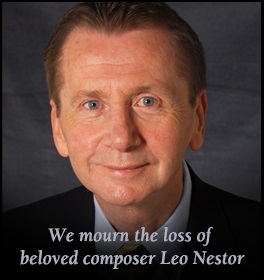
Today, ECS Publishing Group mourns and honors beloved composer Leo Nestor, who passed away on Sunday.
Leo Nestor has been a fixture of E.C. Schirmer’s catalog since 1990. Primarily a composer of choral music, Nestor has published dozens of works through E.C. Schirmer and MorningStar Music Publishers, as well as Oxford University Press, GIA Publications, CanticaNova Publications, and several other publishers.
Nestor served in several educational roles at The Catholic University of America’s Benjamin T. Rome School of Music, including Director of Choral Studies and Director of the Institute of Sacred Music, among others. In addition to his teaching, Nestor was a much sought-after advisor, offering his knowledge and skills to the Conference of Roman Catholic Cathedral Musicians, the Secretariat for Divine Worship, and the international Comitato d’Onore jury.
For Leo Nestor’s Pray Tell obituary notice, click here
For more information on the life of Leo Nestor, click here
In the winter of 2016 and 2017, composer Thomas Keesecker composed a set of piano pieces, which would go on to grow into a hugely popular series. Keesecker saw a need for uncomplicated, introspective, hymn-based pieces that would serve to help us reflect on the themes of the season.
With that need in mind, The Quiet Center, a collection of pieces for Advent and Christmas, became the inaugural book in this series. Most of the pieces are about three minutes long, and several combine two hymn tunes or a hymn tune and folk tune together.
It was followed closely by The Quiet Night, which features music for Christmas and Epiphany, and even includes an optional piano and violin duet.
Following suit, The Quiet Journey came next, with particularly expressive—but not intrusive or busy—settings for Lent and Easter. The composer also included a few “easter eggs” in one of the pieces.
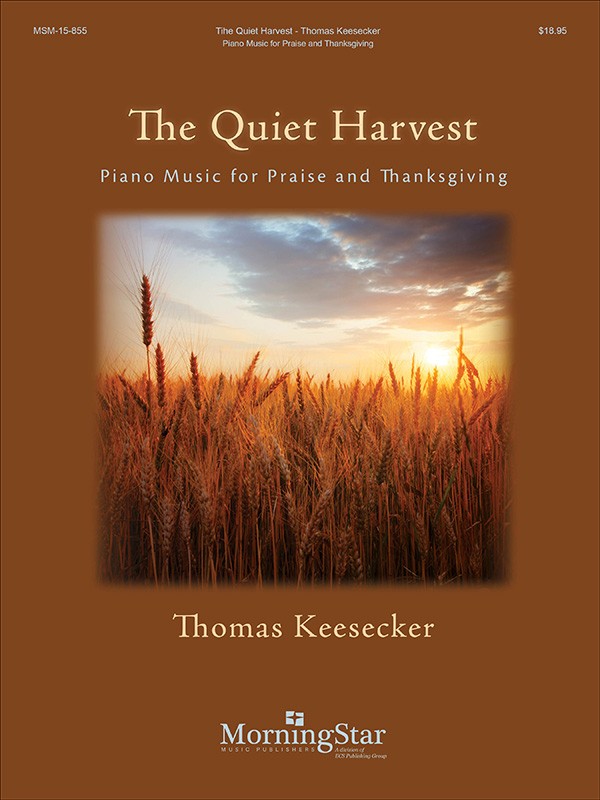
The fourth volume, The QuietHarvest, features music for Praise and Thanksgiving, and, as in earlier cases, the book does a wonderful job of combining tunes together. The composer takes care to give a musical voice to the elements of travel, gathering, and celebration that are integral to the fall season.
Finally, The Quiet Heart will be the last installment in this series. Subtitled “Music for Healing,” this volume will be available in Spring 2020.
The Quiet CenterThe Quiet NightThe Quiet JourneyThe Quiet Harvest
We always love a good composer interview, and this one’s extra exciting for us. Thanks to New Music Box for their work getting to know Juliana Hall, and especially for the video they created!
We’re wrapping up our summer conference season, and wanted to share this list of favorite new choral pieces for school from our TCDA reading session.
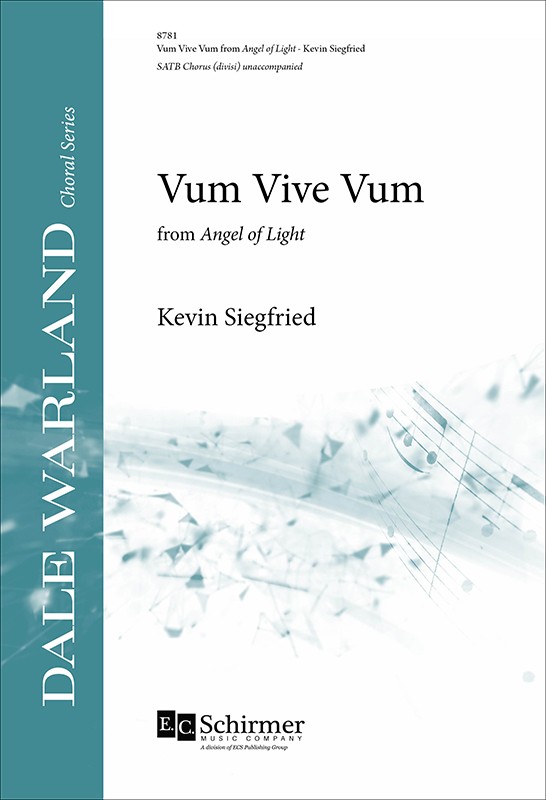
Vum Vive Vum
“Vum Vive Vum” is the central movement of Angel of Light, a cantata based on Shaker themes. A dancing and playful rhythmic ride, it is ideal as a light-hearted opening or closing piece. The text dates from 1844 and is a lively example of a Shaker dance song. The vocal sounds represent a uniquely American form of “mouth music”—a style of traditional singing where nonsense words are used to mimic the sounds of instruments or the rhythms of a dance. Part of the Dale Warland Choral Series. Duration: 2:00
More Love
“More Love” is the cornerstone movement of Songs for the Journey, which was commissioned in 2010 to be performed alongside Gabriel Fauré’s Requiem, and utilizes the same sonorous combination of horns, harp, organ, violas, cellos, and bass. Songs for the Journey outlines and explores similar themes as the traditional Latin Requiem—love, faith, mortality, surrender to an eternal will, etc.—but in a less ecclesiastical framework, with poems and texts drawn from a variety of sources. In assembling the texts, words of a particularly personal nature were chosen to echo Fauré’s intent. The musical style of “More Love” is simple and direct and the message is positive and affirming, making it appropriate for a variety of performance settings. Duration: 3:15
Johnny Comes Marching
Ken Berg’s “Johnny Comes Marching” uses a strong tune and text to speak to the respect with which any nation treats the men and women who serve in their military. Beginning softly, the effect is like a parade that starts in the distance and gradually progresses ever closer to the listener. Following a brief introduction, the first verse is in unison. Each successive verse expands not only the part writing, but the sound and effect. The strength of the harmonic structure, the depth of the textual importance, and a relentless rhythmic drive, make this piece a strong addition to any program. Part of the Darren Dailey Choral Series. Duration: 2:45
Maid of Constant Sorrow
A familiar American folk song is “A Man of Constant Sorrow,” which is sometimes adapted, as in Gwyneth Walker’s setting, to “A Maid of Constant Sorrow.” This is a very simple melody, placed in the key of C major. The message is a mournful one. The soul is troubled, and not at rest. “All through this world, I’m bound to ramble…perhaps I’ll take the very next train.” Then, later, “perhaps I’ll die upon this train.” Some comfort is taken with the lines “I know we’ll meet on God’s Golden Shore.” Approachable vocal writing with a gently flowing piano accompaniment. Duration: 4:15
A Song of Hope
For SSAA voices with a soloist (to which voices add gradually,) the text is as if someone is speaking to their long-dead ancestors. They granted a gift of life and hope for those who came after. Their “names and faiths survive.” And just as those in the past were faced with decisions and made them for the benefit of those who follow, we now have the same responsibility. The music is mostly in unison and remains on one staff even when it divides into multiple parts (which it does in only 14 of the 89 measures). This is a singable piece with an easy but supportive piano part, which could be useful for many ensembles in many situations.
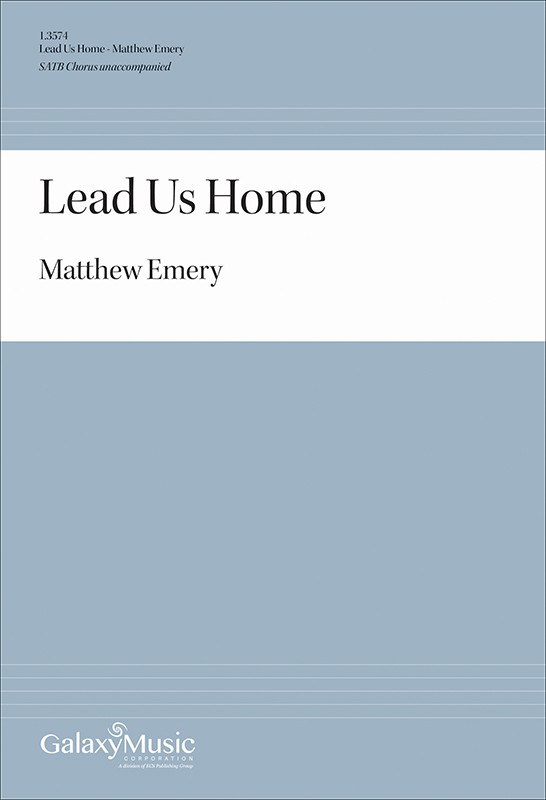
Composer Matthew Emery’s piece Lead Us Home, which has only been published for a few months, has already had a significant number of performances and toured Europe and Canada. This is thanks to the National Youth Orchestra of Canada, who, at the end of each of their concerts while on tour, stand and perform the choral work. To date, the piece has had 18 performances in four countries—quite an accomplishment! Emery was kind enough to give us a glimpse at the compositional process for his piece, read on for his take.
Lead Us Home was commissioned by the National Youth Orchestra of Canada, with generosity from the Patrick Hodgson Family Foundation. I received a phone call from Mitchell Pady (chorus director at the orchestra) in the Spring of 2018 asking if I would write a work that was short, accessible, could be sung in any formation, utilized limited or no divisi, and that could be learned in few rehearsals by non-singers.
The National Youth Orchestra of Canada (NYOC) has a history of performing an English and French madrigal at the end of every concert. Last season they decided to commission new choral compositions for the end of each concert. I was commissioned to write the choral piece in English. I chose a poem by Canadian poet Marjorie Pickthall, altering the text slightly, and replacing the word “star” with “music.” The piece almost wrote itself overnight. I had a working draft quite quickly, Pickthall’s text is very evocative and musical. The words almost set themselves. Lead Us Home follows the form of the poem, with three verses. Each verse is similar in style and mood, with subtle changes of variation and colour. Lead Us Home speaks to the power music holds; its ability to comfort, to transport and heal. In moments of conflict, strife and grief, we turn to music to lead us home and make us whole. —Matthew Emery
Clare Shore’s Day Tripping for violin, cello and piano will be performed in Carnegie’s Weill Recital Hall on July 20th, 2019 by Trio Casals to celebrate the upcoming PARMA Recordings’ release of Trio Casals’ new CD MOTO QUARTO. Other composers whose works are represented on the CD features works are David Nisbet Stewart, Emma-Ruth Richards, Joanne D. Carey, Allyson B. Wells, L Peter Deutsch, Christopher Brakel, Keith Kramer, and Mathew Fuerst.
On July 24, 2019, Shore’s Evocations: Four after Matisse will be performed by Project Fusion Saxophone Quartet on the Bridgehampton Chamber Music Festival.
Zimmermann’s Café Chamber Music will present the premiere of Shore’s Intensities of Degrees for flute (piccolo/alto flute) and piano on October 27, 2019 in Lake Worth Beach, FL, performed by co-commissioning flutists Tammy Evans Yonce, Misty Theisen, and Cathie Apple, with Jennifer Reason, piano.
Shore is the most recent subject of the ongoing project, Nevertheless, She Composed. Currently a social media platform, each NSC interview is being carefully transcribed for a printed anthology. The first edition of Nevertheless, She Composed: A Contemporary Anthology of Women Composers of the Twenty-First Century is scheduled to be published during the spring of 2020. Watch Liz Knox’s interview with Shore below.
Clare Shore, the second woman to earn the Doctor of Musical Arts degree in Composition from The Juilliard School (1984), has received critical acclaim for her works, with reviewers from the New York Times, New York Post, Boston Globe, Washington Post, and others hailing her works as “provocative” … “immensely dramatic” … “unpretentious” … “ingenious and evocative” … “intriguing” … “romantic to the core”. While at Juilliard Ms. Shore studied with David Diamond, Vincent Persichetti, and Roger Sessions, and subsequently with Gunther Schuller. Since then, she has received numerous commissions, awards, and grants, including a 1995 Composer Fellowship from the National Endowment for the Arts.
Shore has taught at Fordham University, Manhattan School of Music, the University of Virginia, George Mason University, and Palm Beach Atlantic College. She currently holds an exclusive publishing contract with ECS Publishing. Other works are found in the catalogs of Arsis Press, Plucked String Editions, and Seesaw Music. Her works are recorded on CRS, Owl Recordings, and Opus One, produced by Grammy Award-winning Elite Recordings.
Summer’s here, which means it’s time to start planning music for the next season, especially choral repertoire.
Of course, the best first step in planning is to reflect on the most recent past season. What went well? What pieces did the choir enjoy? Were there pieces that the congregation reacted to especially positively? Were there pieces that didn’t seem to quite fit the liturgy? Would it be good to give a new piece that didn’t go well another chance? What have we learned together from the selections we have sung, and where might we want to go in the upcoming season?
Many choir directors include “choral classics” in their repertoire every year. While the term means different things to different people, in general we can agree that these are pieces that have stood the test of time and are considered part of the treasury of the Church. These works are excellently crafted, offering choirs an opportunity to grow in their skills. They are often settings of Latin texts, but that doesn’t mean they can’t be sung in English if a good translation exists. Often they are unaccompanied works, but, again, that doesn’t prohibit an organist/pianist from doubling the parts for support. Some choral classics are centuries old, but even our current, fairly young century has its share of works that fit this description.
A little less than two years ago, MorningStar assembled a panel of four choral directors from Catholic cathedrals and parishes to discuss the topic of choral classics, and the starting point for our discussion was a list of such pieces from the panel. The list, organized by time period, shows some basic information about the piece: Composer, title, season/use, and difficulty level, and the initials of the director who suggested the piece. Sometimes publisher was included, but many of these pieces can be found in the catalogs of more than one publisher. It is interesting to note how many of the pieces were held in common among the four participants (noted by bold type), and of course there were also many held by three or two of the four.
This list is a great resource to have available as you’re trying to craft the ideal season. We’re happy to share it with you, and hope that it proves helpful as you choose repertoire in the future.
Greetings to my Choral Director colleagues. During this time of the year (Spring), most of us are heavily involved with our concerts—at schools, colleges, and community venues. I find myself on the go more than ever.
And my favorite mode of travel is the train. I live within walking distance of my local train station here in New Canaan, CT. From there I can easily get to Stamford, CT, where I pick up Amtrak taking me far and wide.
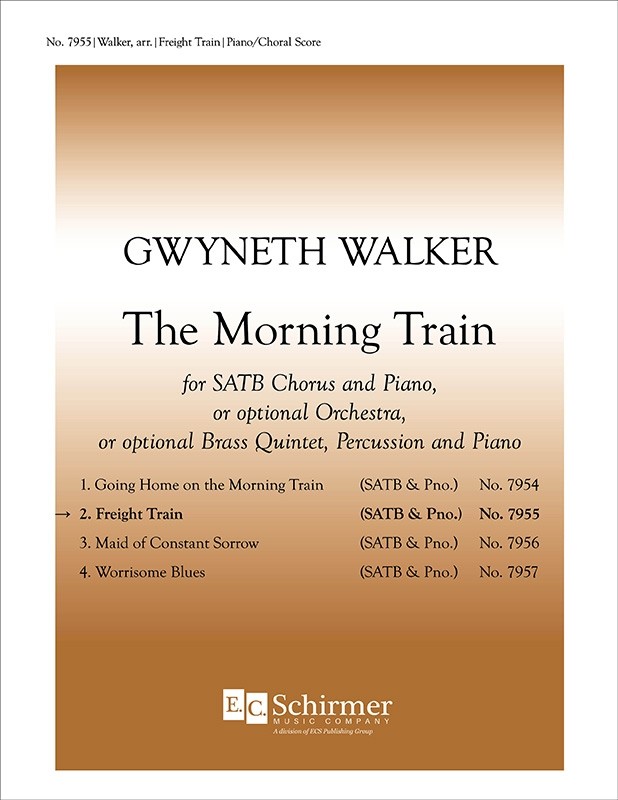
I have always loved trains, and train travel. In fact, trains are referenced in many of my choral and vocal works. One specific set, The Morning Train, is a four-song collection, all about trains. Most of the songs are quite active. An astute listener may hear train whistles, or sounds of passing trains.
The Morning Train is scored for SATB chorus with brass quintet and percussion (or just piano). Plenty of energy!
My friends in the Reading, PA, Choral Society have even made a video of their performance of “Freight Train” (song #2 in the set) while singing in a caboose at the Train Museum!
I hope that you will enjoy singing these songs. And perhaps you will think of me, riding my local train, smiling as I stare out of the window as the miles pass by.
Composer Daron Hagen’s memoir, Duet with the Past, was released this spring. A rare look at the depth and breadth of an artist’s experience, we had a chance to ask the author a few questions and get an understanding of how the book came to be.
Hagen’s Memoir, Duet with the Past
In just the first few pages of the book, the stories you’re sharing are immediately intensely personal. Will people who know you—colleagues, peers, friends, family—find this surprising, or is this your m.o. in everyday life?
As a protege of Ned Rorem’s during the 80s, and then, as his friend from the 90s-onward, I observed with keen interest the interplay between “public” and “private” Ned: as a public intellectual of a variety that is now largely lost in American culture, he published “intimate” (some would say naughty) diaries that readers familiar with the form recognized as highly-stylized accounts of his private life, and not “actual” truth. By the end of his long career as an essayist and diarist, his last volume of diaries was titled, “Lies.” Now, that, if you deconstruct it, is a pretty interesting title for a work in a subjective literary genre. Either he was throwing in the towel, or throwing down the gauntlet—who knows?
All that is to provide context to this: I am, and always have been, an intensely private person and cope, as so many people do, with intense social anxiety. I am shy. The challenge is to overcome the shyness to get to one’s own truth, and, after getting to that, continue reaching. When I teach, I try to help my pupils get to their own truth (which of course is always changing for them): often it takes them a long, long time to get other peoples’ voices—louder voices, more appealingly-packaged “truths”—out of their heads. In short, I don’t think that the tone, language, or “voice” of the book will surprise anyone who knows me. It is, for better or worse, written in my voice.
You mention your family of origin’s Lutheran background and that you attend many Sundays. That was another surprise since we know you as more of a concert composer, and yet faith is ostensibly a big part of your life. What do you make of that? Do you see a distinction between sacred and secular music, or does it all occupy the same plane?
We identified as Lutherans when I was a kid; but my family didn’t attend church steadily. I attended a Lutheran mission church during my senior year of high school because my girlfriend’s parents were devout. My wife was brought up Catholic. When we went to the Catholic Church to ask them to marry us, I was told that the fact that I was divorced would require all sorts of institutional mumbo-jumbo, so two newly-minted Episcopalians were struck when we were married in our home church, Church of the Messiah, in Rhinebeck, New York. While my schedule doesn’t allow me to attend every Sunday, I am fairly regular in my attendance, and I find inspiration in the liturgy, the service, the Process of churchgoing. I’ve never seen any distinction whatsoever between sacred and so-called secular music; music of every sort speaks to the soul—what could be more sacred than that?
What prompted you or how did you make the decision to write a book? How was the experience of writing a memoir different than writing music? How was it the same?
I wrote the book primarily to leave a record of who I thought I was, and what I thought about, for my sons who will—or will not—read it when they get older. They are being, as I was, brought up to venerate and devour books, so I’m pretty certain they’ll read it. I have always found the process of writing prose exactly the same as writing music. I guess that it is just the way I think.
You write about lessons with Ned Rorem and the complete preparedness he required of a student (the passage where you said something to the effect that you had better have everything notated as perfectly as possible comes to mind). Is this something you incorporate and expect in your own teaching? What other strains from previous teachers do you readily see in your own teaching and other artistic work?
Bernard Jacobson, in his superb Foreword to the book, compares and contrasts my intent and impact with Ned’s. I shared my prose with Ned , but, really, our letters were the way that we wrote about writing to one another—as any people who love writing can’t help but do when they correspond. The love of writing I got from my mother, and from my high school writing teacher, Diane C. Doerfler—both forever in my heart. Every composition teacher teaches differently. The way I teach has almost nothing to do with the way I was taught by Ned, and Diamond, and Lenny. I sometimes hear myself sounding a little like Lukas Foss, but that’s a good thing.
As for “strains” —or “influences”— I realized back in the early 80s that I needed to write what I wanted to hear—that it wasn’t in me to package myself into some “Transatlantic” accent suitable for academic and high-end symphonic audiences. Ironically, this made me an outsider, the way that Lukas Foss’ stylistic restlessness made him one. Critics (and colleagues) spend a lot of time trying to track influences from one artist to another: this is a waste of time and actually quite hurtful, because Excellent Work is regularly being sidelined and dismissed by clever careerists in positions of power under the guise of saying that the work is “second-hand” or “derivative.” There’s nothing new under the sun, but the Process of making new things is an honorable and noble one. The rest is politics, not Art.
What did you learn about yourself, particularly as a composer, through writing this book?
I never thought life as an artist was about external validation, necessarily, or fame, or power; but it took a long time, and decades of careful observation of my sister and brother artists (as well as myself) to understand in my bones that “Art will take care of itself. Critics and colleagues will carp. Life will go on. One’s ‘best’ work will be met with skepticism and incomprehension. So relax: concentrate on people and process.” That’s in the book!
What was the process of writing the book like?
I diarized obsessively from 1979-2009. I stopped diarizing when my first son was born a decade ago, and work on the book took the place of keeping a diary. It was written on legal pads on airplanes, in hotel rooms, and at artist colonies, and I flight-tested some of the longer set-pieces on my website blog and during a stint writing for the Huffington Post.
Let’s say someone is getting ready to read the book—they know your name but maybe aren’t as familiar with your work. Do you recommend they start with the book or explore your music first? Do you have a shortlist of pieces to listen to that would add context and make reading the book a more complete experience?
I wish there had been a book like mine out there when I was a composer in my late teens. Part of the function of it is to provide what’s now called “intellectual history” at a time when young American composers often don’t know what they don’t know and so don’t care that they don’t know. Always there is the temptation—particularly now—to proclaim the Year One. This is because it is easier to do that then it is to figure out what one’s progenitors did that might—gasp—actually have been helpful or insightful. In my teens, the enormity of what I didn’t know about music and musicians and the life I was contemplating hit me with the force of a hammer. Artists reinvent the wheel. Really understanding that is a good beginning. One reader in Germany told me that it was taking him a long time to read my book because every time I mentioned a book, an author, a painter, or a piece of music he didn’t know, he set my book aside to read the other book or listen to the piece. He’s my dream reader.
Daron Hagen
Critically-acclaimed composer, operatic polymath, and writer Daron Hagen (b. 1961) is the creator of five symphonies, a dozen concertos, 13 operas, reams of chamber music and more than 350 art songs. “A composer born to write operas” (Chicago Tribune) whose music is “dazzling, unsettling, exuberant, and heroic” (The New Yorker), “Hagen’s music represents a considerable artistic achievement of uncompromising seriousness” (Times Literary Supplement). His “theatrical audacity,” and “gift for big, sweeping tunes” (New York Times) underpin work that “is both highly original and gripping; restless, questioning music that never loses its heart.” (Opera Now Magazine). Opera News describes his opera Amelia as “one of the 20 best operas of the 21st century;” NATS Journal of Singing calls him “the finest American composer of vocal music in his generation.” “To say that Daron Hagen is a remarkable musician is to underrate him. Daron is music,” wrote Ned Rorem in Opera News. His “ruthlessly honest and beautifully written” memoir, Duet With the Past (McFarland, April 2019) “takes him from his haunted childhood to the upper echelons of musical life in New York and Europe” (Tim Page).
Born in Wisconsin, Hagen studied composition with Ned Rorem at the Curtis Institute and David Diamond at the Juilliard School, and then worked privately with Lukas Foss and Leonard Bernstein. During the 90s, he worked as a copyist and editor for numerous concert composers and Broadway shows, including Elliot Carter, Virgil Thomson, Gian Carlo Menotti, and Disney; he also taught for a decade at Bard College, and served on the faculties of the Curtis Institute, New York University, and the Princeton Atelier, among others. He now divides his time between composing, directing, and writing, co-chairs the composition program at the Wintergreen Music Festival, and serves as a member of the Artist Faculty at the Chicago College of the Performing Arts at Roosevelt University.
We’re looking forward to seeing old friends and meeting new ones at the upcoming National Association of Pastoral Musicians (NPM) conference in Raleigh, NC. From July 15-19, MorningStar & E. C. Schirmer will have a booth at the event, and will partner with NPM to present several sessions. Before your schedule fills up, read about these great opportunities to come together and learn from one another.
We are especially excited to sponsor clinician Dr. Eileen Guenther, to share her knowledge and passion regarding Spirituals and their roots in slave narratives!
Monday, July 15
Opening Event 8:00pm
We are proud to be sponsoring this year’s opening night concert, Who’ll be a Witness: The Healing Power of the Spiritual, led by Dr. Eileen Guenther, with musical leadership by Karl Zinsmeister and the choir of White Memorial Presbyterian Church, and by Dr. Lonieta Cornwall and the Shaw University Ensemble.
This is an interactive concert based on Eileen Guenther’s recently-published book, In Their Own Words: Slave Life and the Power of Spirituals. In this program Dr. Guenther combines first-person narratives and former slave interviews with her own commentary, all interwoven with the singing of Spirituals (by the group, choirs, or soloists). There are significant gaps in the historic and cultural education of many Americans; this presentation not only shines a light on the events of the past, but also serves as a means of hope and reconciliation in the present–as this music itself does.
Tuesday, July 16
Beginning Organists Skill Building 4:00-5:00pm Kelly Dobbs-Mickus
An hour-long intensive for beginning organists, including an exploration of easy repertoire for both hymn and solo playing.
Wednesday, July 17
Accessible Choral Music from MorningStar Music 11:45-12:45pm Mark Lawson and Kelly Dobbs-Mickus
Music performed with modest resources can still enrich the liturgy. Come experience quality selections for the church year in a variety of styles, voicings, and instrumentation. Music packet provided.
Instrumental Resources from MorningStar Music 5:15-6:00pm Mark Lawson and Kelly Dobbs-Mickus
Instrumental music holds an important place in your repertoire by helping your assembly connect with the hymns and songs they sing. It also provides many opportunities to involve additional musicians in your parish’s music program. Discover a wealth of resources for solo instruments and ensembles from MorningStar’s expansive instrumental catalog and ways to use and adapt them.
Thursday, July 18
MorningStar Music Presents New Choral Music for the Church Year 10:15-11:15am Mark Lawson and Kelly Dobbs-Mickus
Enliven your choral program with quality music for the church year. A variety of styles, voicings, and instrumentation means there’s something for everyone. Music packet provided.
ECS Publishing Group Presents New Music for Advanced Choirs 2:15-3:15pm Mark Lawson
Realize the potential of your intermediate to advanced choir with music in a variety of styles and instrumentation from this leading publisher of classical repertoire. Music packet provided.
Friday, July 19
Hearts, Hands, and Voices 9:00-10:00am Mark Lawson
Children, made in God’s image, are born with talents that can be expressed in music and art in the service of worship and in the world. We need to teach children that God deserves the best we can give and must provide children with high quality learning experiences that are worthy of their time and attention.
Resource Exhibit Hours
This year’s exhibits will look and feel a little different, but you will still find all the excellent music and other resources that you’ve come to expect from MorningStar! Come by and visit Mark Lawson, Ginny Lawson, and Kelly Dobbs-Mickus and tell us about your conference experience, your reactions to our resources, and your ideas for ways we can help you.
Monday, July 15 9:00pm-11:00pm Gala Opening and Late Night Expo Tuesday, July 16 11:00am-6:00pm Wednesday, July 17 10:00am-1:00pm and 3:00pm-6:30pm Thursday, July 18 10:00am-4:00pm Friday, July 19 9:00am-11:15am










 In Tune blog