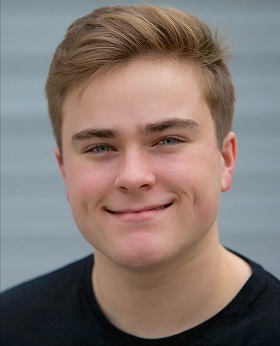
This month we got to know composer Alistair Coleman, currently in his first year at The Juilliard School, and the youngest composer as yet published by E. C. Schirmer. His career as a composer and musician is off and running, and it’s one we’re very excited to follow.
How did you become involved with music?
Music has always been a part of my family. My parents met singing in a symphonic choir in DC and sang semi-professionally in DC choirs, so from an early age, I would observe their rehearsals or be around musical families and friends. In the house, we would always have music playing, or someone would be singing or playing the piano. I first started singing in the Men and Boys Choir at St. Paul’s K Street in Washington, DC, where I built a strong musical foundation by singing English choral music each week. From there, I started piano lessons and would often improvise at the piano.
When did you know you wanted to be a musician? A composer?
Since music has always been a part of my life growing up, I could not imagine my life without it. I knew from a very young age that I wanted to be a musician, but the idea of being a composer didn’t occur to me until I was in middle school. My choral and instrumental teachers would encourage me to compose pieces for our school ensembles, and I received mentorship from my first composition teacher, Gary Davison. Beyond the satisfaction of realizing my musical intentions in a piece, I instantly loved the collaborative process of getting people together to bring a new piece to life. I especially love the excitement of a first rehearsal, because no one knows what to expect, and even though composing can often feel like a solitary sport, it’s incredibly fun to work with all kinds of musicians in these collaborative and experimental settings.
Was there a critical moment when you became a composer, or was it gradual work and realization?
Before taking piano lessons, I would noodle/improvise on the piano, especially since my older brother, Ben, took lessons and I often looked up to him. When I began lessons, occasionally, I would become bored practicing my assigned pieces, so instead, I would find myself improvising melodies and chords on the piano. Over time, I would begin to improvise whole new pieces, and once I learned enough about music theory and notation, I would write down these improvisations. Those written-down improvisations would become my very first compositions. The very first performances of my pieces took place at my middle school, since my choral and instrumental teachers would encourage me to compose pieces for our school’s ensembles. The idea of a becoming a composer gradually became more real to me when I spent summers at music programs like the Curtis Institute Young Artist Program and the Atlantic Music Festival.
Tell us about your experience with some of your composition teachers.
I currently study with Dr. Robert Beaser, chairman of composition at The Juilliard School in New York. This is our first year working together, and I have learned a lot about myself as a composer under his guidance in this short amount of time. During our lessons, we’ll work through new drafts of pieces I’ve written, and he’ll always encourage me to push myself to explore and uncover new ideas, material, and approaches that I would’ve never thought were possible.
In high school, I studied with Dr. David Ludwig, composition faculty member at the Curtis Institute of Music in Philadelphia. I first met him through the Curtis Young Artist Summer Program, where at the time, I had almost exclusively written choral music. During my high school years, he encouraged me to seek opportunities to write more instrumental works, so during our lessons we would work through new pieces for string orchestra, Pierrot ensemble, string quartet, piano trio, and solo instrumental works, to name a few. He would enable me to learn about the limitations and opportunities for different instruments, and help me experiment with different approaches and extended techniques. Even though I still compose a lot of choral music, this was a very informative experience that I continue to explore (and probably will never stop exploring).
When I was in middle school, my first composition teacher and mentor was Gary Davison, a composer, conductor and organist based in Washington, DC. Gary has always been a very influential person in my life, and he was the first teacher to encourage me to pursue composition. I first started writing choral and vocal pieces, and we would work together to realize my compositional goals, but we would also pay close attention to harmony and voice leading. He helped me build a strong foundation, and he is still a very important mentor to me who I often look to for advice.
Where or when do you feel most inspired to compose?
Every day, I love to go for a run or take long walks. As a student at Juilliard, I love exploring New York City, and will often venture to Central Park. These experiences give me time to myself to think about and reflect on the work I’m doing, either in school or in my compositional work. Growing up, my family and I would travel to the Blue Ridge Mountains in Virginia to ski and hike in the winter and summer, respectively. It’s an incredibly scenic place, and I’ve always been inspired when I reflect on my experiences there. My string orchestra piece, Constellations, is based on memories of hiking with my family to the peak of one of the mountains to stargaze, where it would be dark enough to see the milky way.
Once you are inspired, what’s your process for writing a new piece?
I always improvise on the piano when I start a new piece. It’s an unpredictable process of sitting at the piano for sometimes several hours, and trusting my instincts to go in several directions. Without thinking, I would write ideas down to form a collection of material I could use in a piece. Then, I will return to these collections to play through, synthesize, and even create multiple versions of ideas. During this process, the piece will begin to reveal itself to me, where I start to think about structure, but also pay very close attention to the material, or the identity of each piece. If it’s a choral piece, I always start with the text, and I will often improvise at the piano while singing the text to discover what feels most naturally to me. Although with any piece I write, choral or instrumental, I will always sing each line, as I strive for a sense of line in my music that is intrinsically natural and can connect with people.
What is your favorite medium to write for?
Choral music comes most naturally to me, since my musical foundation is based in singing, but I’m always excited to work with new ensembles, both choral and instrumental. I love writing pieces for a specific person or ensemble, especially when it’s a musician I know very well. In these settings, I feel I can really target the player’s strengths and communicate something to the audience in the piece about the connection or relationship I have to the performer.
How much does a piece change from its inception to its publication?
There is so much I learn from a rehearsal, workshop, or performance. It can be really hard not to get caught up with the excitement (and joyful terror) of hearing a brand new piece for the first time. I try to stay really engaged to learn as much as I can about the piece. I will often ask players to demonstrate different techniques, or show me alternative ways of notating ideas to approach a piece that is idiomatic for the musician’s instrument, without sacrificing my compositional intentions. Sometimes, I’ll try something new that may not work as well as what I intended, so it’s very informative to have players demonstrate a better way of communicating or notating a certain idea. Occasionally, players even introduce me to new sounds or techniques I may want to use in future pieces. The process is very experimental and collaborative, and especially since composing can be a solitary sport, working with other musicians as a team to bring a new piece to life can be such a rewarding experience.

Tell us about a memorable musical experience.
In the summer of 2017, I was fortunate to be selected as a winner of the NextNotes High School Competition, sponsored by the American Composers Forum. In June, I traveled to Minneapolis to share an extended weekend with five other high school composers from around the US. It was an incredible experience. We all attended workshops with professional mentor composers, in-depth rehearsals with professional musicians, a concert of our music, and we were exposed to artists and music events throughout the Minneapolis-St. Paul area. The best part was to share rehearsals, concerts, meals, and experiences with the other composers, because even though we came from different areas, backgrounds, and experiences, we all shared a love for creating music. We all still keep in touch, and I’m so glad the American Composers Forum has created this amazing opportunity for high school composers throughout the country.
Alistair Coleman is a young composer from Washington, DC. Most recently, he was appointed the Composer-in-Residence of the National Philharmonic Orchestra and Chorale. His piece, Of Radiance and Light, was commissioned by the National Philharmonic and premiered at Strathmore Hall in November 2016. His music has been programmed broadly, including performances by the Atlantic Music Festival Orchestra, Maryland Classic Youth Orchestra, Houston Brass Band, Boston University Marsh Chapel Choir, Takoma String Ensemble, Cathedral Choral Society, and National Symphony Orchestra Youth Fellows.
With three published works, Alistair is the youngest composer ever published by E. C. Schirmer Music Company in its nearly one-hundred-year history. He is a winner of the American Composers Forum NextNotes Competition, a 2017 National YoungArts winner, the 2016 “Audience Choice Award” winner from Symphony Number One, winner of the 2013 NAfME Young Composers Competition, and a two-time winner of the Maryland State Young Composers Competition. He has received recognition in the ASCAP Morton Gould Young Composer Awards.
Alistair has studied composition at the Lake Champlain Chamber Music Festival, Atlantic Music Festival, Curtis Young Artists Summer Program, Oberlin Summer Composition Workshop, and the New York Summer Music Festival. His teachers have included Richard Danielpour and David Ludwig, faculty members at the Curtis Institute of Music in Philadelphia. Alistair began undergraduate studies in 2017 at The Juilliard School, studying with Robert Beaser.
 In Tune blog
What a moving piece! ‘Images from Fallingwater’ stirs the intellect and takes one t0 a place where sound and imagination become one. Structurally and emotionally this music holds together with an openness and honesty that belies the youthfulness of its composer. ‘Images’ is less the work of a young writer; more the outpouring of a mature artist who understands his medium well.
LikeLike